
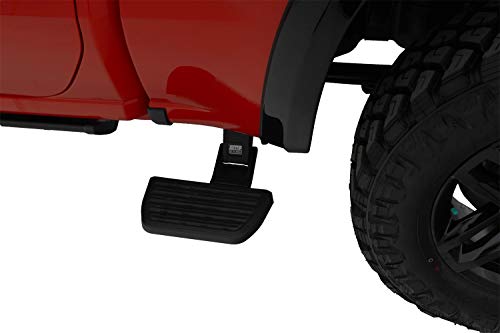


AMP Research BedStep2 Retractable Bed Step
We built the BedStep2 to solve a problem every truck owner faces: safe, convenient access to the bed without climbing on tires or tailgates. This retractable step mounts behind your rear wheel and flips down in seconds when you need it, then tucks away out of sight when you don't.
The aluminum construction keeps weight down while delivering a 400-pound load capacity. Whether you're loading gear, securing a tarp, or reaching across the bed, the BedStep2 gives you a stable platform exactly where most people naturally step anyway—making it second nature from the first use.
Our design team focused on durability and ease of installation. You get a bolt-on mount that works with most full-size pickups, a textured step surface for traction in wet or muddy conditions, and corrosion-resistant finishes that hold up season after season.
What makes the BedStep2 work
Installation and vehicle compatibility
The BedStep2 installs using vehicle-specific mounting brackets that attach to existing frame points behind your rear wheel. Most installations take 30–45 minutes with basic hand tools—no welding, no drilling through body panels.
We manufacture application-specific kits for Ford F-Series, Chevy Silverado, GMC Sierra, Ram, Toyota Tundra, and Nissan Titan models. Each kit includes brackets engineered for that truck’s exact frame geometry, along with stainless hardware and a detailed instruction sheet with photos for every step.
Materials and construction details
We use extruded aluminum for the step platform because it delivers the best strength-to-weight ratio for daily use. The 6061-T6 alloy resists flexing under load while keeping the entire assembly under 12 pounds—light enough for the spring-assist mechanism to retract smoothly every time.
The step surface features a raised diamond-plate texture that channels water and mud away from your boot, maintaining grip even in freezing rain or after muddy job sites. A black powder coat finish covers all aluminum and steel components, providing UV and salt resistance that holds up in both desert heat and northern winters.
Real-world use and load capacity
The 400-pound rating isn’t just a number—we test every BedStep2 design with cyclic loading that simulates years of daily use. That capacity means you can step up confidently whether you’re wearing work boots and a tool belt or winter gear with extra layers.
Most users deploy the step dozens of times a week: grabbing tools from a bed-mounted toolbox, tying down loads, installing tonneau covers, or washing the cab roof. The step puts you 10–12 inches higher than ground level, which is often enough to reach over the bed rail comfortably without stretching or using the tailgate as a ladder.
More solutions for safer truck bed access



Rated 4.8 by verified buyers


Common questions about the BedStep2
The BedStep2 is designed for trucks at stock ride height with factory or similarly sized aftermarket wheels. Lift kits over 3 inches may require bracket modifications or extended mounting hardware depending on your specific suspension setup.
Oversized wheels (35-inch or larger) can interfere with step deployment if they extend significantly beyond the factory wheel well. Check clearance by measuring 8 inches vertically behind your current wheel—that's the space the step needs to flip down fully.
The BedStep2 uses vehicle-specific mounting brackets that bolt directly to existing frame holes behind the rear wheel. Most applications require no drilling—you're using attachment points already built into your truck's frame.
Installation involves positioning the bracket, inserting the provided bolts through frame holes, and torquing to spec. The step assembly then pins into the bracket using a stainless steel pivot bolt. Complete hardware and detailed instructions are included with every kit.
Yes, the BedStep2 can be installed on either the driver or passenger side, and many owners install one on each side for maximum bed access. Each side requires its own complete kit since the mounting brackets are side-specific.
Most users start with a driver-side installation since that's typically where you approach the truck. If you find yourself frequently loading from the passenger side—at a dock, job site, or against a garage wall—adding a second step makes sense.
Routine maintenance is minimal. Rinse the step and pivot mechanism after driving in mud or heavy road salt to prevent buildup around moving parts. The sealed bearings keep dirt out of the hinge, but external cleaning prevents grit from accumulating on surfaces.
If retraction slows after extended use, apply silicone spray lubricant to the gas strut shaft—avoid petroleum products that can damage internal seals. Check mounting bolts annually and re-torque if needed, especially in freeze-thaw climates where thermal cycling can cause minor settling.
The raised diamond-plate texture on the step surface channels water away and provides mechanical grip even when wet. The aluminum doesn't become slippery like painted steel when covered in mud or ice.
That said, use common sense in freezing conditions. If ice builds up on the step, clear it before use just as you would with any other surface. The texture helps significantly, but physics still apply—frozen surfaces reduce traction regardless of the step material.
The BedStep2 mounts behind the rear wheel, well forward of the rear bumper and hitch area, so it doesn't interfere with trailer connections, backup cameras, or hitch accessories. You can tow normally with the step installed.
The step retracts flush against its mounting bracket when not in use, keeping it out of the way during backing maneuvers. The only consideration is ground clearance on steep approach angles—the step adds roughly 4 inches of protrusion when retracted, similar to a factory step or rock slider.
Yes, the BedStep2 works perfectly with tonneau covers, bed caps, and toppers. The step gives you the extra height needed to reach over the bed rail and access covers or secure loads inside a capped bed.
Many owners install the BedStep2 specifically because a tonneau cover makes bed access more challenging—you need to reach over the rail to unlatch or roll up the cover. The step puts you at the right height to work comfortably without stretching or standing on the tire.